
Solar Panel Orientation and Tilt: Getting the Best Output from Central Coast Roofs
The "perfect" solar orientation is sometimes the wrong choice. Most Australian guides recommend north-facing at 20-30° tilt as the gold standard, and they're not wrong about the maximum total output. But maximum total output isn't always the most valuable system. A west-facing array that captures more late-afternoon production might be worth more to a household that uses most of its electricity in the evening, despite producing less in total. Understanding orientation and tilt as variables, not as a single right answer, is how you get the system that actually fits your home.
### The Australian baseline: north-facing at latitude tilt
Australia is in the southern hemisphere, which means the sun sits in the northern half of the sky for most of the day. A solar panel pointing directly at the sun's average position generates the most total energy over a year.
For the Central Coast (latitude around 33° south), the optimal annual production angle is:
- Orientation: Due north (azimuth 0°) - Tilt: Around 28-30° from horizontal
A panel installed at these angles will produce the maximum possible annual kilowatt hours for that location. Most published "system output" estimates assume a north-facing array at optimal tilt.
### What happens when you deviate from optimal
The good news is that solar production is forgiving of orientation deviations. Rough output reductions compared with north-facing at 30° tilt:
- North-east or north-west facing: 1-3% reduction in annual output - East or west facing: 10-15% reduction in annual output - South-east or south-west: 20-25% reduction in annual output - Due south: 30-35% reduction in annual output
Tilt deviations are smaller still:
- 0° (flat): ~10% reduction compared with optimal tilt - 10°-50° tilt range: All within 3-5% of optimal - Vertical (90°): ~30-40% reduction (rarely relevant for residential rooftop)
The takeaway: anywhere within "north-east to north-west" and 10°-40° tilt is producing within 5-10% of perfect. That covers a huge proportion of Australian roofs.
### When east or west-facing is the right call
A north-facing roof maximises total daily production, with the peak around midday. East-facing roofs produce most in the morning. West-facing roofs produce most in the afternoon. For households whose electricity usage patterns lean toward one end of the day, matching the array to consumption can be more valuable than maximising total production.
West-facing makes more sense when: - The household runs aircon heavily in the afternoon and evening - High consumption happens during the 2pm-6pm window - The roof has limited north-facing area
East-facing makes more sense when: - Morning showers, kitchen appliances, and home office loads dominate - A heat pump hot water timer runs in the morning hours - The roof has limited north-facing area
For homes with consumption monitors (or a year of detailed bills), it's worth analysing actual usage patterns before deciding on orientation. The "obvious" north-facing answer isn't always financially best.
### Split arrays, using multiple roof faces
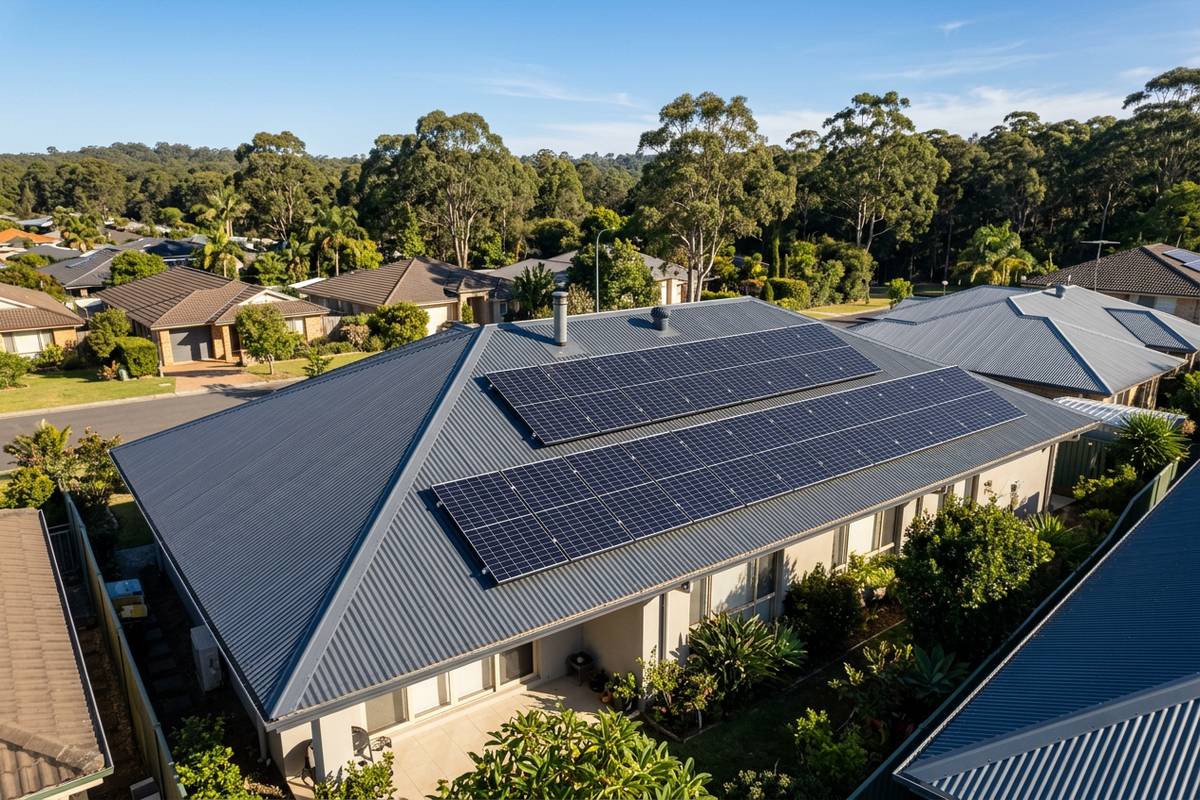
Many Central Coast homes have hip roofs or gable patterns where no single face has enough area for the desired system size. A split array, panels on two or more roof faces, is a common solution.
How it works: A modern hybrid or string inverter with multiple MPPT (maximum power point tracking) inputs can handle two or more arrays facing different directions. Each string operates independently, so the underperforming string doesn't drag down the better one.
Why it's often a good choice: - More total panel area, which means more total production - Spreads production across the day (east + west covers morning and afternoon better than a single midday-peaked north array) - Avoids the need for over-tilted or cramped layouts
What needs attention: - The inverter must have multiple MPPT inputs (most modern residential inverters do) - The installer must design the string layout to keep panels on the same string facing the same direction (mixing orientations on a single string causes performance issues)
### When to use tilt frames
Tilt frames raise the front edge of panels off the roof to create a steeper angle than the roof surface itself. They're common on:
- Flat roofs, almost always uses tilt frames to angle panels to 15-25° - Low-pitch roofs (under 10°), tilt frames bring the panels to a more efficient angle and help shed water and debris - Roofs facing east or south where extra tilt can partially compensate, though the gains are modest
Trade-offs of tilt frames: - Visually more prominent than flush-mounted panels - Wind loading on the array is higher, which requires stronger mounting and more attention to engineering - Some council development applications treat tilt-framed arrays differently (worth checking locally) - Aesthetic concerns matter more in heritage or front-of-house installations
For a standard pitched-roof Erina home, tilt frames are usually unnecessary, the roof itself provides adequate tilt.
### Shading: the biggest hidden orientation factor
Even a perfectly north-facing array at perfect tilt can underperform badly if it's partially shaded for hours each day. Common shading sources on Central Coast homes:
- Trees, especially mature gum trees and pines, which can shade significant portions of an array for parts of the day - Chimneys and roof vents, small but persistent shading sources - Neighbouring two-storey buildings, relevant in denser suburbs - Antennas, satellite dishes, air conditioning units on the roof itself
A good site assessment includes a shading study, most installers use a digital tool that maps shading across the full year at your specific roof. If significant shading exists, options include: - Microinverters or DC optimisers, improves performance under partial shading - Different panel layout, moving panels to less-shaded sections - Tree trimming, sometimes the cheapest fix - Smaller array, accepting fewer panels in unshaded areas rather than more panels with shading
### Frequently Asked Questions
#### Is east-west the same as north-facing in total output?
No. A single east-facing array produces about 10-15% less total annual energy than the same array north-facing. A split east-and-west array (panels on both sides) produces close to north-facing total output, but with the production spread differently across the day.
#### Does panel orientation affect winter performance more than summer?
Yes. In winter the sun is lower in the sky and shines from further north. Panels tilted toward the north at a steeper angle (closer to latitude tilt) capture proportionally more winter sun than flat or south-tilted panels. The orientation penalty for non-north-facing arrays is more pronounced in winter than summer.
#### Can I install panels on a south-facing roof at all?
Yes, but expect 30-35% lower annual output than the same panels facing north. Whether this is worth it depends on the cost-per-kWh of the install and whether north-facing roof space is available. For homes with no other option, south-facing solar still provides net financial return, just less generously than a north-facing install.
#### Does panel tilt affect cleaning frequency?
Slightly. Steeper tilts shed dust, leaves, and bird droppings more effectively than near-flat arrays. Very flat arrays (under 10° tilt) accumulate soiling faster and may benefit from occasional manual cleaning.
### Planning a Solar Installation in Erina?
Get a free, no-obligation site assessment from a local SAA accredited solar installer serving the Central Coast.
[Button, Insert Custom Code: "Chat With Our Team", href: https://solarerina.com.au]
Talk to a Local Central Coast Electrician
Get a free, no-obligation quote from a licensed electrician serving the Central Coast.