

Solar Inverter Replacement, When and Why Inverters Need Swapping
Your solar monitoring app is showing zero. Or it's showing erratic dropouts where production stops mid-afternoon and resumes hours later. Or you're getting alerts you don't understand and your inverter display is flashing an error code that means nothing to you. These are the signs of an inverter that needs attention, and inverters are far more likely to need replacement during a solar system's lifetime than the panels themselves.
#### Why Inverters Wear Out Faster Than Panels
Solar panels are essentially solid-state silicon with no moving parts. Their lifespan is measured in decades, with quality panels still producing over eighty percent of their rated output after twenty-five years. Inverters, by contrast, contain switching components, capacitors, cooling systems, and control electronics that operate continuously under heat and electrical stress. Even well-built inverters typically need replacement somewhere between ten and fifteen years from installation, sometimes earlier if they've been operating in particularly hot conditions or if the original unit was at the budget end of the market.
Most Central Coast solar systems installed between 2010 and 2015 are now approaching or past the typical inverter replacement window. For homeowners with systems in that age range, an inverter that's still working might be running at reduced efficiency or could fail at any time. Knowing what to look for helps you plan a replacement on your terms rather than dealing with an emergency outage.
#### The Warning Signs Worth Acting On
The clearest indicator of an inverter problem is a drop in daily generation that can't be explained by weather or seasonal changes. If you compare your current output to what your system produced a year ago at the same time of year and you're seeing a substantial drop, the inverter is one of the most likely causes.
Other warning signs include error codes on the inverter display (any persistent error code is worth investigating), audible fan noise that's louder or more erratic than usual, the inverter shutting down during the hottest part of the day (overheating), and visible signs of physical wear like discolouration of the housing or unusual smells. Any of these warrants a service call rather than waiting for total failure.
If your system has stopped generating entirely and the inverter shows no display or a constant fault code, the inverter has likely failed. Don't attempt to reset or troubleshoot beyond turning the AC isolator off and on once, repeated power cycling on a failed inverter can cause additional damage.
#### What Replacement Actually Involves
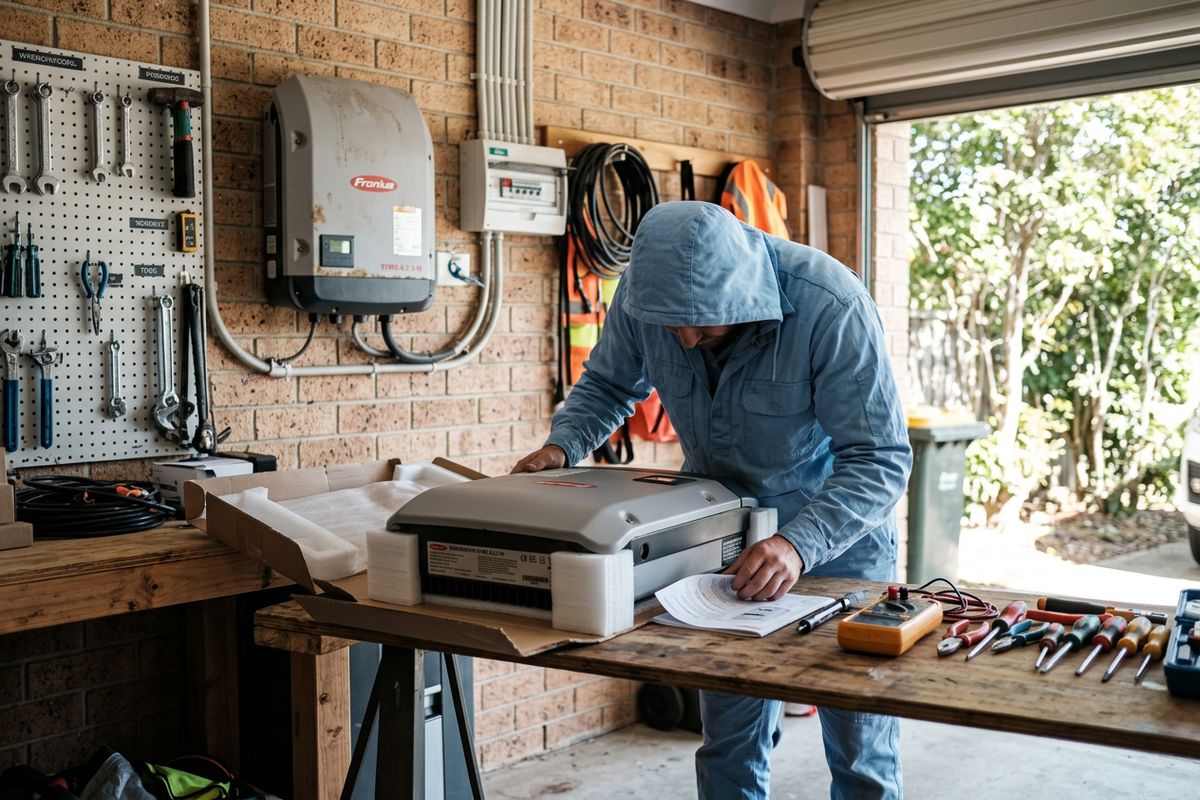
Replacing a solar inverter is a structured process that takes most of a day for a typical residential system. The general flow is: isolate the system at the AC and DC isolators, disconnect the old inverter from the wiring, remove it from the wall, mount the new inverter in the same position (or relocate if the original position was problematic), reconnect the AC and DC wiring to the new terminals, configure the new inverter's settings, commission the system through your distributor's network connection requirements, and verify operation through the monitoring app.
The replacement inverter doesn't need to be the same brand as the original. Many Central Coast homeowners use the inverter replacement as an opportunity to upgrade, moving from an older string inverter to a modern hybrid model that supports future battery addition, or selecting a brand with better warranty terms and local support than the original.
#### Hybrid Inverter Upgrades, Worth the Extra Cost?
If your existing inverter is failing or has failed and you're considering battery storage in the next few years, the inverter replacement is your opportunity to install a hybrid model and avoid having to do it twice. The cost difference between a comparable hybrid inverter and a standard string inverter is generally modest, and far less than retrofitting hybrid capability later or adding a separate battery inverter via AC coupling.
The hybrid conversion is most cost-effective at the inverter replacement point. If you're paying for the labour to swap the inverter anyway, the marginal cost of choosing hybrid over standard is small. If you're definitely planning a battery within five years, hybrid is almost always the right call.
#### Warranty Claims and What's Actually Covered
If your existing inverter is still within its manufacturer warranty period, the manufacturer should provide a replacement unit at no cost for the hardware. What's not always covered is the labour to install the replacement, which can be a meaningful proportion of the total replacement cost.
Some manufacturers have extended warranty programs that cover both parts and labour, but these vary by brand and product line. Fronius, for example, has historically offered extended warranties through their Solar.web platform for systems registered at installation. Sungrow and other major brands have their own warranty programs with varying terms.
When making a warranty claim, your installer (or the original installer if you can reach them) coordinates with the manufacturer. Keep the documentation from your original installation, including the inverter serial number, install date, and any warranty registration confirmations. Without these, warranty claims become more difficult.
#### Frequently Asked Questions
Can I run my solar system without the inverter while waiting for replacement?
No. The inverter is the component that converts DC power from the panels into AC power your home can use. Without a working inverter, your panels can't deliver power to your home or to the grid. You'll be on grid power only until the replacement is complete.
Will switching inverter brands cause any issues?
Generally no, as long as the new inverter is sized appropriately for your existing solar array. The replacement installer will confirm the array configuration matches the new inverter's input specifications. Some configurations may require minor wiring adjustments.
Do I need to notify my energy distributor when replacing an inverter?
Yes, any change to grid-connected solar equipment requires a connection update with your distributor. Your installer handles this paperwork as part of the replacement. The notification ensures your distributor's records reflect the actual installed equipment and that the new unit meets current connection requirements.
Is it safe to keep using my old inverter if it's still producing some output?
If the inverter is showing error codes, overheating, or generating reduced output, it should be inspected. Some inverter faults can cause electrical safety issues over time, including DC arc faults that pose fire risk. A precautionary inspection is far cheaper than addressing the consequences of a failed inverter that wasn't replaced in time.
#### Inverter Issues at Your Erina Property?
Get a free, no-obligation site assessment from a local SAA accredited solar installer serving the Central Coast.
<div style="text-align: center; margin: 20px 0;"> <a href="https://solarerina.com.au" style="display: inline-block; background-color: #1e3a8a; color: #ffffff; padding: 14px 32px; text-decoration: none; font-weight: 600; font-size: 16px; border-radius: 6px; font-family: sans-serif;">Chat With Our Team</a> </div>
Talk to a Local Central Coast Electrician
Get a free, no-obligation quote from a licensed electrician serving the Central Coast.