

Solar Hot Water vs Heat Pump: Which Wins for Erina Homes?
Which actually delivers cheaper hot water for an Erina home in 2026, solar hot water or a heat pump? It's the most common adjacent-to-solar question Central Coast homeowners ask, and the answer depends on more than just upfront price. Both systems run circles around traditional electric storage and gas hot water systems on running cost. Choosing between them comes down to roof space, household size, climate, and how the system pairs with your existing or planned solar panels.
### How each system actually works
Solar hot water uses rooftop collectors to heat water directly. Two main configurations exist:
- Thermosyphon (close-coupled): Tank sits on the roof above the collectors. Hot water rises naturally into the tank. Simple, no pumps, but visually obvious and the tank sits in the weather. - Split system (ground-mounted tank): Collectors on the roof, tank on the ground at the side of the house, connected by a small pump. Cleaner roofline, more flexibility for tank size and placement.
Both rely on direct solar heating of the water itself. On cold or cloudy days, an electric or gas booster element kicks in to top up the temperature.
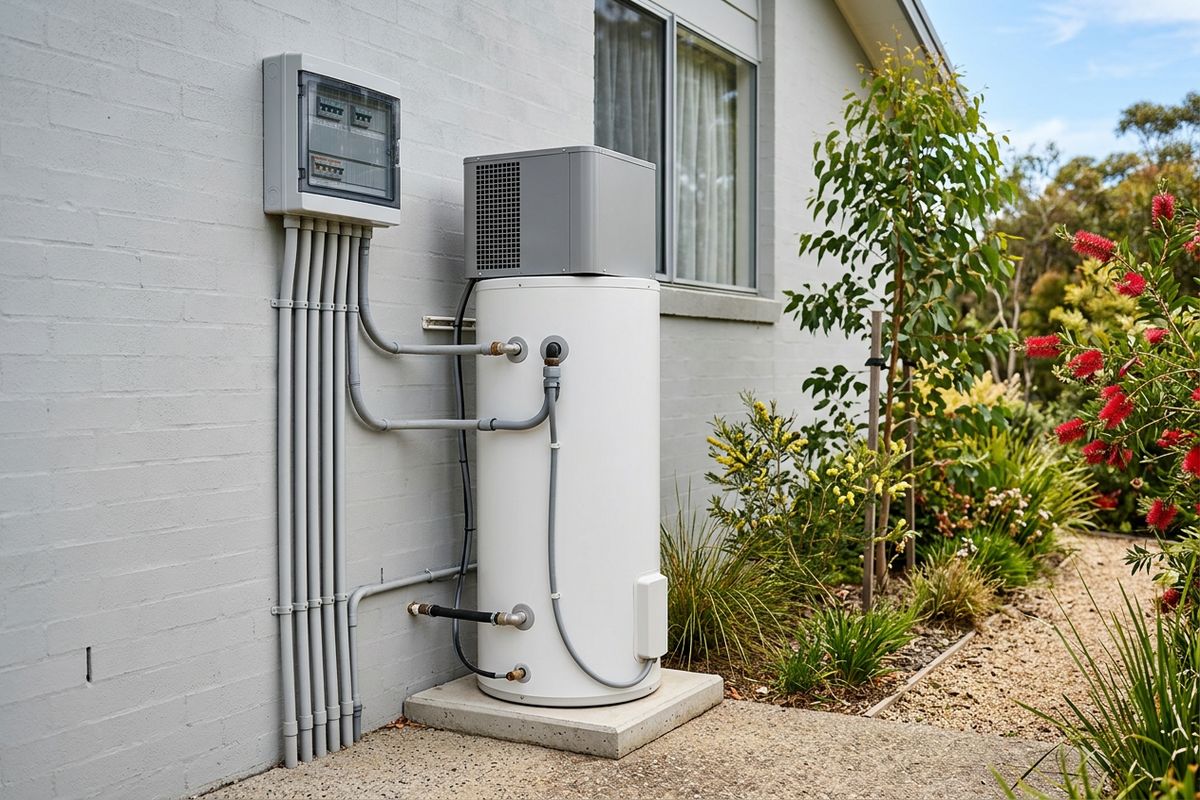
Heat pumps work differently. They use refrigeration technology, like a reverse-cycle air conditioner, to extract heat from the surrounding air and transfer it into the water tank. Highly efficient because they're moving heat rather than generating it: typically 3 to 4 units of heat output per unit of electrical input. The unit looks similar to an air conditioner condenser, usually installed at ground level beside the house.
### The efficiency numbers
For a typical 4-person Central Coast household consuming around 200 litres of hot water per day:
- Electric storage hot water: ~3,000-3,500 kWh per year - Gas storage hot water: Equivalent to ~2,500-3,000 kWh of energy input - Solar hot water (with boost): ~700-1,200 kWh per year (boost dependent on weather and household pattern) - Heat pump hot water: ~700-1,000 kWh per year (depending on COP and timer programming)
Both solar hot water and heat pump are dramatically more efficient than electric or gas storage. The choice between them is closer than the choice against the older technologies.
### Where each one wins
Solar hot water wins when: - Your hot water demand is high (large household, frequent hot water use) - Your roof has good north-facing space dedicated to the collectors - Your climate has consistent sunny weather year-round (less of a fit for cooler southern Australia, but reasonable for the Central Coast) - You want passive, low-maintenance operation - You don't mind the visual presence on the roof (or you've chosen a split system)
Heat pump hot water wins when: - Your roof space is limited or reserved entirely for solar panels - You already have or are planning a solar PV system (heat pumps run on electricity, which can be powered by your panels at zero marginal cost) - You want flexible installation locations (ground-level beside the house works fine) - You're prioritising integration with smart home and time-of-use scheduling - Your household size is moderate (heat pumps scale less well to very high hot water demand)
### The solar PV interaction
This is the consideration that's tipped the balance toward heat pumps in recent years for households also installing rooftop solar.
A heat pump runs on electricity. If you have solar panels and a timer that runs the heat pump during peak solar hours (typically 10am to 3pm), the heat pump's already-low electricity demand is met from your own solar production at essentially zero marginal cost. The combined system (solar PV + heat pump on solar timer) often outperforms standalone solar hot water on total household running cost.
Solar hot water uses your roof for water heating instead of electricity generation. For homes with limited roof space, choosing solar hot water means giving up panel space that could otherwise be generating electricity for the whole house, not just for hot water.
### Upfront costs
In 2026, rough Australian price ranges for installed systems:
- Solar hot water (thermosyphon): $3,500-$5,500 - Solar hot water (split system): $4,500-$7,000 - Heat pump hot water: $3,500-$6,000 (with rebates, sometimes lower) - Standard electric storage (replacement only): $1,500-$2,500 - Gas instantaneous (replacement only): $1,500-$3,000
Heat pumps are often eligible for state-level rebates and the federal Cheaper Home Batteries Program (in some configurations), which can significantly reduce the net upfront cost, making them more competitive than the headline price suggests.
### Lifespan and maintenance
Solar hot water systems: Tank lifespan typically 10-15 years. Roof collectors often last 20+ years. Anti-freeze systems (less relevant on the Central Coast) require periodic checks.
Heat pumps: Compressor lifespan typically 10-15 years. Filter cleaning and occasional refrigerant checks are part of maintenance. Some models include cold-weather modes if temperatures drop below the operating range (rarely an issue on the Central Coast).
Both systems have similar lifespan ranges. The maintenance pattern is different but the total ownership cost over 10-15 years is broadly comparable for typical installations.
### Frequently Asked Questions
#### Can I run a heat pump entirely on my solar panels?
Yes, heat pumps typically consume between 500 and 1,500 watts when running, which is easily covered by even a small rooftop solar system during daytime hours. A timer programmed to run the heat pump during peak solar production (10am-3pm) often results in near-zero running cost.
#### Does solar hot water still need a booster?
Yes, almost all solar hot water systems include an electric or gas booster element for cloudy days, long stretches of low sun, or unusual high-demand periods. Well-designed systems have the booster active only when genuinely needed, often less than 20 per cent of total water heating energy.
#### Which is quieter?
Solar hot water systems are silent. Heat pumps produce some noise when running, typically 40-55 decibels at the unit, similar to an air conditioner outdoor unit. Installation location matters: heat pumps should be placed where the noise won't disturb bedroom windows or neighbours.
#### Can I retrofit a heat pump onto my existing solar PV system?
Yes, in most cases. A heat pump installed alongside an existing solar PV system requires no changes to the solar system itself, it just connects to the home's electrical supply like any other appliance. The added load is well within a typical home's available capacity.
### Planning Your Hot Water Upgrade in Erina?
Get a free, no-obligation site assessment from a local SAA accredited solar installer serving the Central Coast.
[Button, Insert Custom Code: "Chat With Our Team", href: https://solarerina.com.au]
Talk to a Local Central Coast Electrician
Get a free, no-obligation quote from a licensed electrician serving the Central Coast.