
Off-Grid and Hybrid Solar Systems for Rural Central Coast Properties
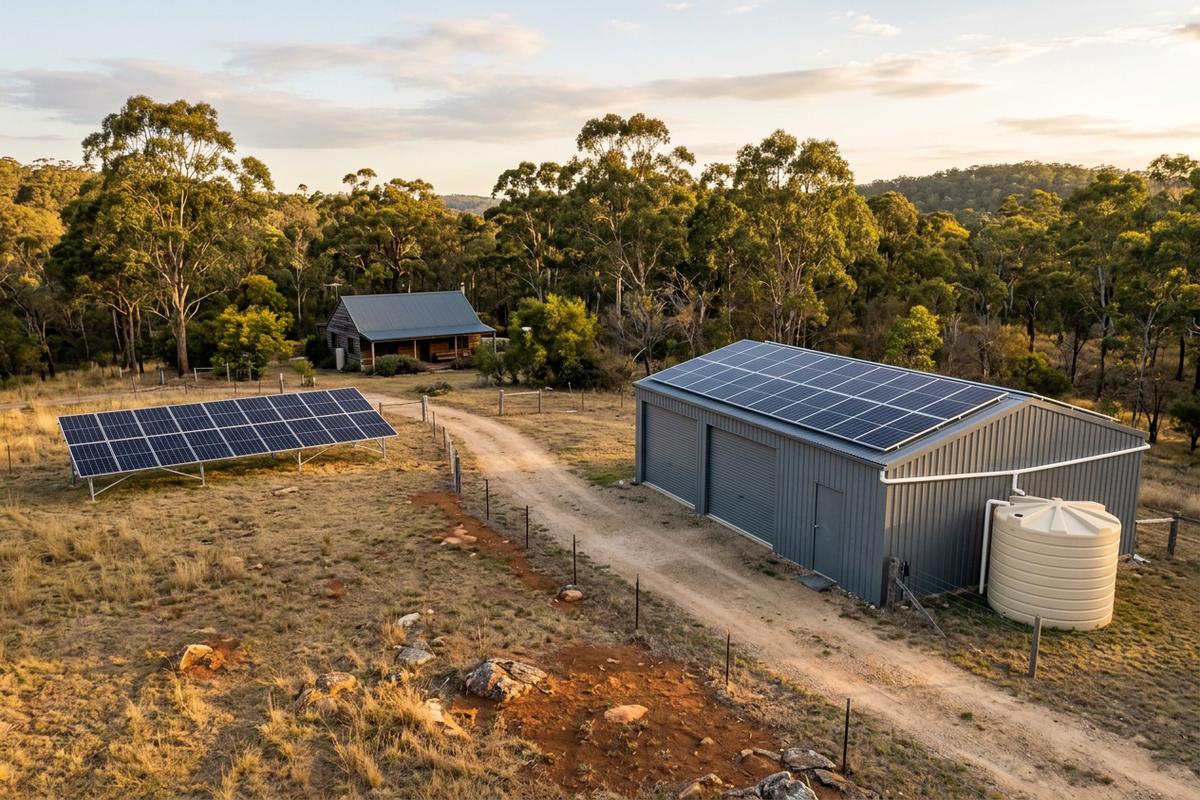
Stand-alone power systems aren't only for remote outback properties. Across the Central Coast, particularly in the rural fringe around Somersby, Mangrove Mountain, and the bushland properties west of Kulnura, homeowners face genuine grid connection challenges. New connections can run into tens of thousands of dollars depending on distance from existing infrastructure. Properties already connected sometimes face frequent outages, voltage issues, or single-phase limitations that make modern household loads impractical.
Off-grid and hybrid solar systems solve these problems by either replacing the grid entirely or supplementing it intelligently. The right choice depends on your specific property, your usage patterns, and the trade-offs you're willing to accept.
#### Off-Grid vs Grid-Connected Hybrid, The Real Distinction
A true off-grid system has no connection to the electricity grid at all. Everything the property consumes comes from solar generation plus battery storage, with a backup generator covering extended periods of poor weather or unusually high demand. The system has to be sized to cover the worst weeks of the year, generally late autumn and winter when solar generation is at its lowest and household demand may be at its highest.
A grid-connected hybrid system uses solar and battery storage as the primary source but maintains a connection to the grid as a backup. The grid covers periods when solar and battery can't keep up, and any surplus from the panels can be exported when the battery is full. This approach is significantly cheaper than full off-grid because the system doesn't need to be sized for worst-case scenarios, the grid fills the gaps.
For most rural Central Coast properties with existing grid connection, hybrid is the practical answer unless the existing connection is genuinely unreliable. For new builds in areas with prohibitive grid connection costs, off-grid often makes more economic sense than paying for the grid extension.
#### Sizing an Off-Grid System Properly
Off-grid system design is genuinely different from grid-connected solar. The fundamental shift is that you can't draw from the grid when production falls short, the system has to cover your needs or you go without power. This changes how generation and storage are sized.
The starting point is detailed analysis of household consumption. Not just total daily usage, but when that usage occurs, what the peak loads are, and how much variation there is between high-demand and low-demand days. Critical loads like medical equipment, refrigeration, and water pumps need to be guaranteed. Discretionary loads like air conditioning and entertainment systems can be designed around solar availability.
Generation needs to be sized to cover at least twice the average daily consumption, sometimes more, to account for cloudy periods and seasonal variation. Battery storage needs to cover several days of autonomy at typical winter generation, with a backup generator handling the remainder. The exact ratios depend on your location, your usage profile, and your tolerance for the generator running occasionally.
#### SAPS Accreditation and Compliance
Stand-alone power systems in Australia are accredited separately from grid-connected solar. The Solar Accreditation Australia (SAA) framework includes a SPS (stand-alone power systems) category that installers must hold to design and install off-grid systems eligible for any applicable rebates and to ensure compliance with the Australian standard AS/NZS 4509.
A general grid-connected solar installer is not necessarily SAPS accredited. When evaluating installers for an off-grid project, confirm they hold the SPS category specifically and ideally have a portfolio of completed off-grid installations in similar conditions.
#### The Generator Question
Almost every off-grid system includes a backup generator. The role of the generator is to cover extended poor weather, unusual demand peaks, and the rare occasions when the battery runs flat. A well-designed system uses the generator perhaps a few days per year, not constantly.
Generators are typically diesel or propane, sized to recharge the battery during a single run and capable of supplying critical loads while running. Modern off-grid generators integrate with the battery management system to start automatically when the battery reaches a low state of charge, run for the time required to recharge, and shut down automatically.
The generator is a key part of the economics. A larger battery means a smaller generator and less frequent generator running. A smaller battery means more generator running and higher fuel costs. The right balance depends on your fuel availability and your tolerance for generator noise.
#### Common Property Profiles for Off-Grid on the Central Coast
Three broad property profiles tend to suit off-grid systems in the Central Coast region. First, rural properties with no existing grid connection and quoted connection costs that exceed the cost of an off-grid system. Second, properties with existing grid connection that's chronically unreliable, frequent outages, voltage problems, or single-phase limitations that the distributor won't address. Third, new dwellings on existing rural properties where the cost of running grid to the building site exceeds the value of grid connection.
Hybrid systems suit properties where grid connection exists and is reasonably reliable but expensive, where the homeowner wants to minimise grid dependence without going fully off-grid, and where battery autonomy through outages is valued.
#### Frequently Asked Questions
How much more expensive is an off-grid system than grid-connected solar?
Significantly more. A capable off-grid system typically costs two to four times what an equivalent grid-connected solar plus battery system costs, because the off-grid system has to handle worst-case scenarios while the grid-connected version relies on the grid for backup. The comparison only makes sense when factoring in alternative costs like grid connection.
Can I add appliances later without re-sizing the system?
Off-grid systems should be sized for known future loads, including potential additions. Adding significant loads after installation may exceed the system's design capacity and require additional panels, battery, or generator capacity. Plan for foreseeable additions during the original design.
What happens if I want to connect to the grid later?
Most off-grid systems can be modified to connect to the grid if it becomes available. This typically involves adding a grid-tie inverter or converting the existing inverter, and the work needs to be done by an SAA-accredited installer. The system continues to function in islanded mode during outages.
Do off-grid systems need more maintenance than grid-connected ones?
Yes, generally. The battery system requires periodic capacity checks, the generator needs servicing as per the manufacturer's schedule (oil changes, filter replacements), and the overall system needs annual electrical inspection. A maintenance contract with your installer is common for off-grid setups.
#### Exploring Off-Grid Solar on the Central Coast?
Get a free, no-obligation site assessment from a local SAA accredited solar installer serving the Central Coast.
<div style="text-align: center; margin: 20px 0;"> <a href="https://solarerina.com.au" style="display: inline-block; background-color: #1e3a8a; color: #ffffff; padding: 14px 32px; text-decoration: none; font-weight: 600; font-size: 16px; border-radius: 6px; font-family: sans-serif;">Chat With Our Team</a> </div>
Talk to a Local Central Coast Electrician
Get a free, no-obligation quote from a licensed electrician serving the Central Coast.