

Home Battery Storage in Erina, Solar-Paired Sizing for Central Coast Homes
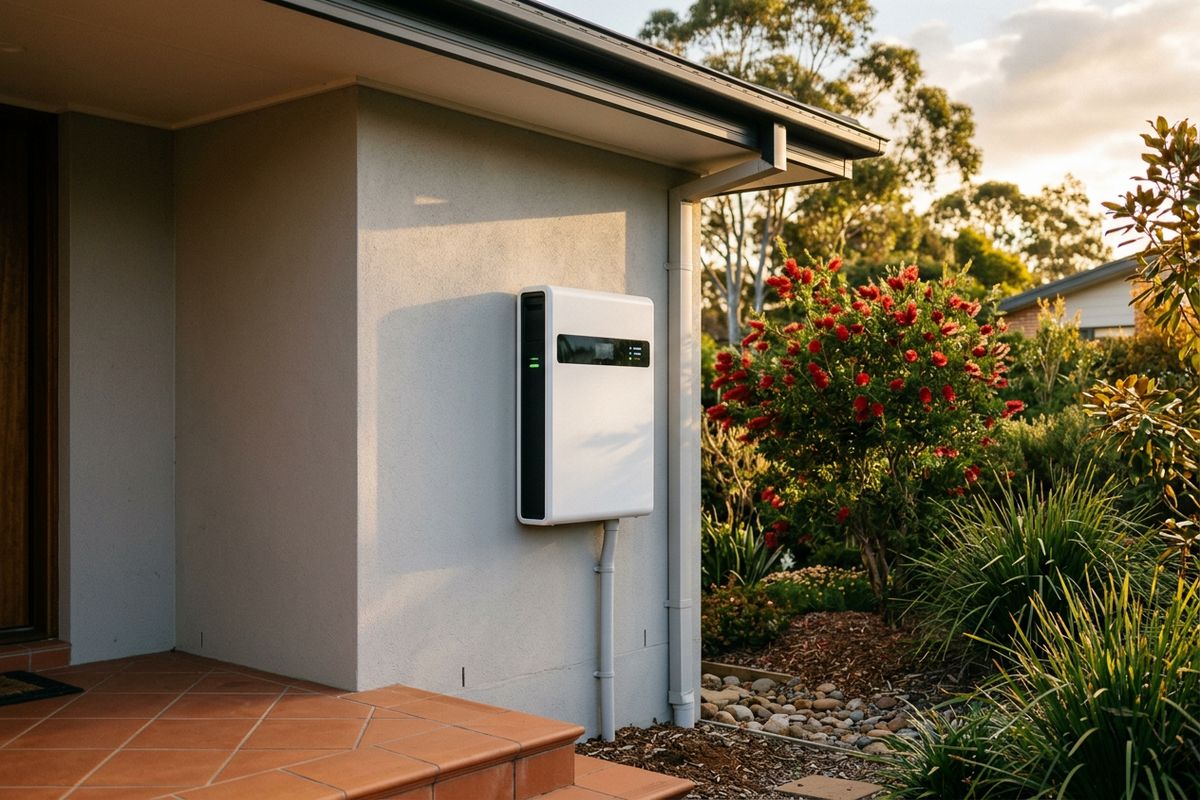
Most solar households across the Central Coast are giving away their best energy. The panels generate strongly through the middle of the day, the household exports the surplus to the grid at a feed-in tariff that's a fraction of what grid electricity costs to buy back, and the family arrives home in the evening to start consuming grid power at premium rates. The economics are upside down. A home battery flips them right way up.
#### Why Battery Sizing Is About When, Not Just How Much
The conversation about battery sizing usually starts with kilowatt-hours of storage. That's the wrong starting point. The right starting point is what time of day you actually use power. Two Erina households with identical annual electricity consumption can have completely different battery requirements based on when their power is used.
A retired couple home all day, running the dishwasher and washing machine in the afternoon, are self-consuming most of their solar already. Their battery needs to cover evening lighting, cooking, TV, and overnight standby, maybe four to six kilowatt-hours of useful storage.
A family with school-age kids and both parents working away from home is exporting almost everything during the day and importing heavily from 5pm onwards. Their battery needs to capture more daytime surplus and discharge across a longer evening peak, closer to ten kilowatt-hours of useful storage, possibly more if they're charging an EV at night.
#### How a Hybrid Inverter Changes the Maths
Whether you can add a battery cleanly to your existing solar depends almost entirely on your inverter type. If your solar was installed in the last few years, there's a reasonable chance it's a hybrid inverter, capable of accepting both DC solar input and DC battery input through the same unit. Adding a battery in this case is mechanically and electrically simple: mount the battery, run the cable, configure the firmware.
If your existing inverter is a standard string inverter (no battery input), retrofitting becomes more involved. You have two options. The first is replacing the inverter with a hybrid model, which makes for a cleaner end result but adds the cost of a new inverter on top of the battery. The second is adding an AC-coupled battery, a battery with its own dedicated inverter that connects to your home's electrical system independently. AC coupling works well and often costs less than replacing your existing inverter, but it adds a second inverter to your setup which means another component that needs servicing over its lifetime.
#### Tesla Powerwall, Sungrow, and BYD, How the Big Three Differ in Practice
The three battery brands you'll see most often quoted for Central Coast homes are Tesla Powerwall, Sungrow, and BYD. They all do the same fundamental job. The differences come down to capacity, modularity, inverter integration, app experience, and price.
Tesla Powerwall is the simplest from a homeowner's perspective. It's an all-in-one unit with built-in battery inverter, polished monitoring app, and a single warranty covering the whole package. The newer model has solid usable capacity for most homes. It tends to sit at the premium end of the market and supply has been intermittent in Australia over the last couple of years.
Sungrow batteries are modular. You start with a base capacity and add modules as your needs grow or your budget allows. They pair particularly well with Sungrow hybrid inverters, which are widely used in Australian residential installations. The app is functional but less polished than Tesla's.
BYD also offers modular configurations and is known for solid build quality. BYD batteries are compatible with a wide range of third-party inverters, giving installers more flexibility when designing systems. They're often the value play of the three brands when configured correctly.
The right answer for your home isn't the "best" battery, it's the battery that best matches your inverter, your usage pattern, and your budget. A good installer will recommend based on what fits your situation rather than what they have on sale that month.
#### What Backup Actually Looks Like During an Outage
One of the most common reasons Erina homeowners add a battery is for backup power during grid outages. The reality of backup is more nuanced than the marketing usually suggests. Whether your battery can keep your whole home running during a blackout depends on the battery's continuous power output (kW), not just its stored energy (kWh).
Most single-unit home batteries deliver enough continuous power to run typical household loads, lights, fridge, internet, TV, microwave, basic cooking. Where they struggle is with high-current appliances starting simultaneously, particularly air conditioning compressors, large heat pumps, or induction cooktops on full output. If full whole-home backup is important to you, this is something to specify upfront, usually it means either selecting a higher-output battery model or stacking multiple battery units.
For most homes, partial backup of essential circuits is the practical sweet spot. Your installer can configure the system to back up your most critical loads (fridge, internet, lighting, a few power points) while letting non-essential circuits drop during an outage. This stretches the battery far further than trying to power everything.
#### Frequently Asked Questions
Can I add a battery to a solar system that's only a few years old?
Most likely yes, if your existing inverter is hybrid or if you're open to AC coupling. The age of your solar isn't the issue, the inverter type is. Get your installer to inspect what's already installed and recommend the cleanest path forward.
How do I check what my evening electricity usage actually is?
Your electricity bill won't show this, it shows total consumption. To see your time-of-use pattern, log into your retailer's app or web portal where most providers show daily and hourly usage breakdowns. Some smart meters also support exporting data to third-party apps for more detailed analysis.
Is the upfront cost of a battery worth it?
It depends on your usage pattern and the gap between your import tariff and feed-in tariff. The bigger that gap, the better the battery economics. For most Central Coast homes with significant evening usage, batteries pay back over time through reduced grid imports and the eventual benefit of backup capability. Your installer should give you honest numbers based on your actual situation.
Can I add another battery later if my needs grow?
With modular batteries (Sungrow, BYD), yes, you add capacity by adding modules. With Tesla Powerwall, you can install multiple Powerwall units alongside each other to expand capacity. The original installation should be designed with this in mind if expansion is a possibility.
#### Curious About Adding a Battery to Your Erina Home?
Get a free, no-obligation site assessment from a local SAA accredited solar installer serving the Central Coast.
<div style="text-align: center; margin: 20px 0;"> <a href="https://solarerina.com.au" style="display: inline-block; background-color: #1e3a8a; color: #ffffff; padding: 14px 32px; text-decoration: none; font-weight: 600; font-size: 16px; border-radius: 6px; font-family: sans-serif;">Chat With Our Team</a> </div>
Talk to a Local Central Coast Electrician
Get a free, no-obligation quote from a licensed electrician serving the Central Coast.